
Studded tire engineering
New Scandinavian and European regulations are changing how studded tires are designed, tested, and approved. Tire manufacturers must now balance winter safety, road wear reduction, particle emissions, EV performance, and sustainability requirements while accelerating time-to-market.
We support tire manufacturers from early-stage concept development to simulation, testing, and approval preparation for Scandinavian and other regulated winter tire markets.
Our work covers the full stud development process, from stud design and technical specifications to testing and approval preparation. Integrated engineering + accredited testing support through our subsidiary BD Testing.
OUR SOLUTIONS HELP SUPPORT:
✔ Regulation-ready studded tire concepts
✔ Lower road wear and particle emissions
✔ EV-optimized winter tire performance
✔ Lightweight and sustainable stud technologies
✔ Faster approval and market readiness
Tell us your target (ice grip, wear, noise, EV), and we’ll shape the development plan around it.

Supporting greener and more durable alternatives to traditional studded tires
How Black Donuts Supports Modern Studded Tire Development
Our Process: From Concept to Approval Preparation
- Target setting – performance targets, application requirements, regulatory objectives.
- Concept development and 3D modelling – alternatives and advanced engineering design concepts.
- Patent and market review – existing solutions, technical trends, and market requirements.
- Stud hole design – dimensions for retention and functionality.
- Simulation – forces, retention, and operating behavior under different conditions.
- Stud placement optimization – quantity and placement for grip, wear, and compliance support.
- Test tire manufacturing support – compounding, construction, studding and prototype preparation.
- Prototype Testing & Evaluation – indoor and outdoor testing, and refinement based on measured results.
Our development approach focuses on balancing winter performance, durability, reduced road wear, and regulatory compliance.
TYPICAL OUTCOMES INCLUDE:
✔ Improved grip performance on icy surfaces
✔ Support for studded tire type approval compliance
✔ Reduced noise and road wear
✔ Long-lasting winter tire performance
How Studded Tires Are Tested for Scandinavian Markets: BD Testing — Accredited Tire Testing
BD Testing is a testing laboratory No. T274, accredited by FINAS Finnish Accreditation Service according to SFS-EN ISO/IEC 17025: 2017 requirements. BD Testing is also an approved expert HA-012, approved by the Finnish Transport Safety Agency, TRAFICOM.


This enables structured, credible testing support to complement engineering and approval preparation work.
Why Choose Us?
Integrated Tire & Stud Engineering +
Studs alone do not create high-performing studded winter tires. Tire design, stud design, and stud placement must work together as one system. Black Donuts develops tire and stud solutions together, balancing grip performance, durability, road wear, noise, and regulatory compliance through an integrated engineering approach.
Collaboration Across the Winter Tire Industry +
Black Donuts works closely with stud manufacturers, tire manufacturers, universities, testing organizations, legislators, IP specialists, and studding machine suppliers. This cooperation helps accelerate development, testing, and approval preparation while supporting practical and regulation-ready studded tire solutions.
Accredited Testing Support +
Our subsidiary BD Testing supports type approval and winter tire testing, including over-run testing (homologation support), ice grip evaluation, stud retention testing, wear analysis, and field performance testing. This helps manufacturers reduce development risk and prepare products for approval more efficiently.
Black Donuts combines tire engineering, stud development, simulation, accredited testing, and approval support within one integrated workflow for modern studded tire development
CITYSTUD — Future-Ready Lightweight Stud Technology
Black Donuts has developed CITYSTUD, an advanced lightweight stud technology designed for evolving winter tire requirements. CITYSTUD supports industry needs related to road wear reduction, lower particle emissions, reduced noise potential, sustainability, and EV-oriented winter tire applications through a lightweight engineered polymer body and patented carbide pin retention technology. Unlike conventional metal stud bodies, CITYSTUD utilizes a lightweight engineered body structure that enables greater design flexibility, reduced weight, and highly precise stud geometries.
Patented Carbide Pin Retention Concept

Lightweight Engineered Body Structure
- High-strength, wear-resistant structure
- Wide operating temperature capability
- Low moisture absorption characteristics
- Recyclable material potential
- Enables highly precise and advanced stud geometries
not achievable with traditional cold-forming methods
Patented Carbide Pin Retention Technology
- Engineered to utilize the elasticity of the body structure
- Designed to maintain high carbide pin pull-out force
throughout the stud lifespan
Key Benefits Include:
✔ Reduced road wear and lower particle emissions
✔ Lower stud weight and reduced noise potential
✔ Greater stud design flexibility and geometry optimization
✔ Support for evolving EV winter tire requirements
✔ Recyclable material opportunities
✔ Advanced lightweight stud architecture
while maintaining winter grip performance and driving comfort.
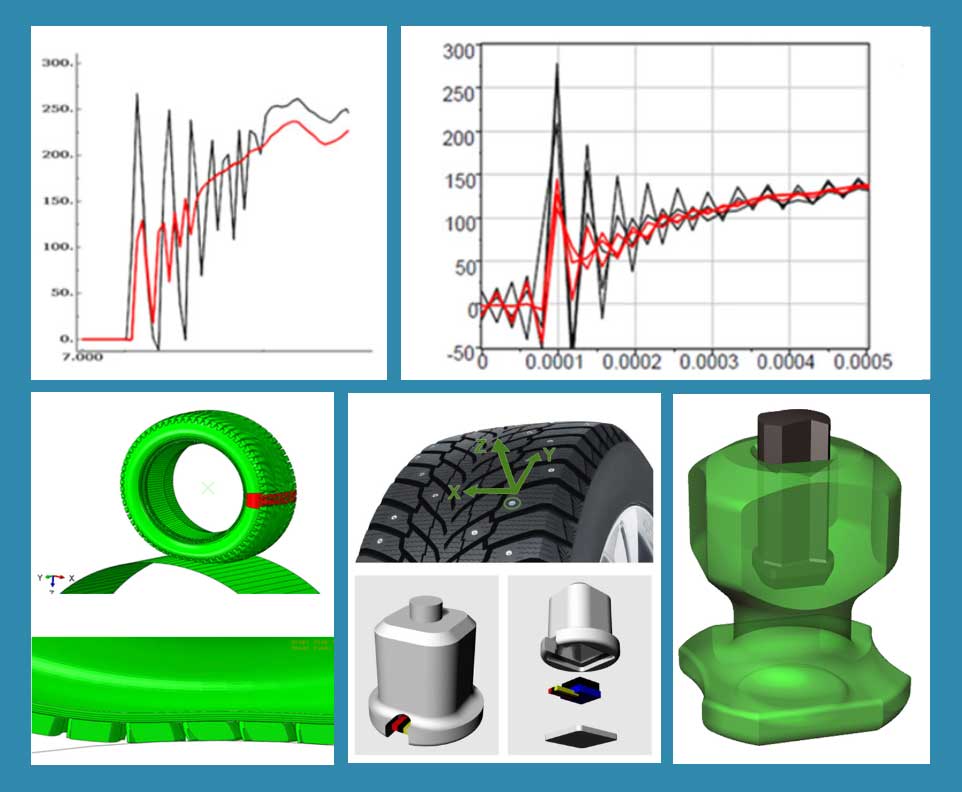
CITYSTUD supports the development of next-generation studded winter tires balancing traction performance, durability, sustainability, and evolving regulatory requirements.
Quality & Compliance
Black Donuts operates under certified quality and environmental management systems
supporting engineering, testing, and product development activities.
[ ISO 9001 ] [ ISO 14001 ] [ Bureau Veritas ]

Discuss Your Studded Tire Development Project
The Nordic winter tire industry is being forced to rethink traction performance, road wear, sustainability, EV requirements, and future approval readiness. Whether you have an early-stage concept, a prototype under evaluation, or an existing studded tire requiring optimization, Black Donuts can help accelerate the next phase of development through engineering, simulation, testing, and approval readiness activities.
Our engineering and testing teams work with manufacturers developing studded winter tire solutions for Scandinavia and other regulated markets, helping reduce development risk, improve approval readiness, and accelerate market entry. All discussions are handled confidentially.
Early-stage discussions, feasibility reviews, and
confidential development inquiries are welcome.
Contact Form
FAQ: Studded Tire Development for Scandinavian and European Markets
What are the new Scandinavian studded tire regulations?
Studded tire requirements in the Nordic region increasingly focus on controlling road wear while maintaining winter safety. In Finland, Traficom’s updated regulation introduces stricter road wear limit values and stud mass requirements in phases. For C1 passenger car tires, the stricter requirements apply to new type-approval applications from 1 January 2025 and to C1 tires manufactured from 1 January 2027. For C2 and C3 tires, the corresponding dates are 1 January 2027 for new type approvals and 1 January 2029 for manufactured tires. The regulation also refers to the updated SFS 7503:2022 road wear test method.
How do EU requirements affect winter tire development?
At EU level, tire requirements are mainly linked to type approval, labeling, rolling resistance, external rolling noise, wet grip, snow grip, and ice grip performance. Studded tire use and approval requirements are not fully harmonized across Europe and may depend on national rules. This means manufacturers need to consider both EU/UNECE tire requirements and country-specific winter tire or studded tire regulations.
How are EVs changing studded tire development?
Electric vehicles create new design priorities for winter tires because they are often heavier, deliver instant torque, and produce less powertrain noise. This increases the importance of stud durability, road wear control, noise behavior, rolling resistance, and winter grip balance. For studded tires, the stud, tread, compound, and tire construction need to be developed as one system.
How can manufacturers reduce road wear in winter tires?
Road wear can be reduced through optimized stud weight, stud geometry, stud protrusion, stud number and placement, tread pattern design, compound behavior, and tire construction. The goal is to reduce pavement wear and related particle emissions while maintaining winter traction and safety performance.
What testing is required for studded tires?
Testing requirements depend on the target market and approval route. For Finnish studded tire type approval, the tire–stud combination must meet defined road wear limits, and the road wear test is based on the SFS 7503 method referenced by Traficom. Studded tire development may also include stud retention evaluation, ice grip testing, wear analysis, noise assessment, and documentation for approval preparation.
What is regulation-ready studded tire development?
Regulation-ready development means designing the tire, stud, compound, and stud configuration with approval requirements in mind from the start. It includes target setting, simulation, prototype development, road wear evaluation, grip and durability testing, documentation, and approval preparation.
How long does studded tire approval take?
The approval timeline depends on tire category, stud concept, prototype readiness, test availability, documentation, authority process, and whether redesign is needed after testing. The safest approach is to plan approval preparation early in the development process to reduce delays before market introduction.
Can studded tires be optimized for lower particle emissions?Yes. Road wear from studded tires is linked to road dust and PM10 particle emissions in Nordic winter conditions. Optimizing stud weight, geometry, protrusion, stud layout, tread design, and tire construction can help reduce road abrasion and related particle generation while maintaining winter safety performance.
Does Black Donuts support approval preparation?
Yes. Black Donuts supports tire manufacturers with engineering, simulation, testing coordination, and approval preparation activities for studded tire development projects.
Can Black Donuts support lightweight stud technologies?
Yes. Black Donuts develops lightweight stud concepts focused on reduced road wear, lower particle emissions, EV-oriented winter tire requirements, and future winter mobility needs.
What industries does Black Donuts work with?
Black Donuts works with tire manufacturers, stud manufacturers, testing organizations, universities, and winter tire industry stakeholders globally.