Black Donuts Featured in Tire Technology International Annual Review 2026
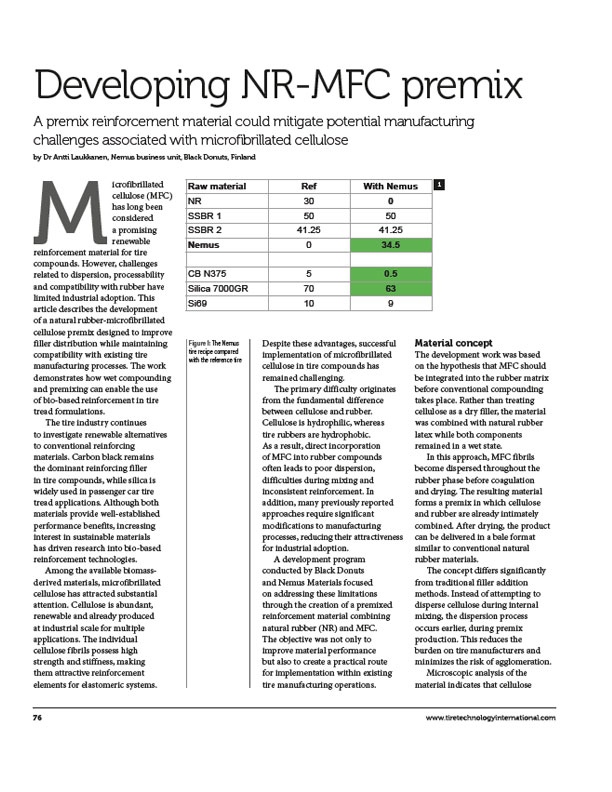
Black Donuts and Nemus Materials are featured in Tire Technology International Annual Review 2026 with an article on the development of natural rubber–microfibrillated cellulose (NR–MFC) premix for tire compounds. Written by Dr Antti Laukkanen, CTO of the Nemus Business Unit, the article presents a premix technology designed to address the processing challenges of cellulose-based reinforcement and support its integration into existing tire manufacturing processes.
At a glance
Technology: Natural rubber–microfibrillated cellulose (NR–MFC) premix
Research focus: Cellulose dispersion, rubber compound processability and reinforcement efficiency
Key findings: Promising laboratory results for partial replacement of conventional fillers
Development stage: Laboratory-scale proof of concept
Developing cellulose-based reinforcement for tire compounds
Microfibrillated cellulose (MFC) is a renewable material with potential as a reinforcing component in rubber compounds. However, its use in tire manufacturing presents challenges, particularly in achieving uniform dispersion and compatibility with conventional rubber processing. The main difficulty arises from the different material properties of cellulose and rubber. Cellulose is hydrophilic, while tire rubbers are hydrophobic, making direct incorporation of MFC into rubber compounds difficult. To address these limitations, Black Donuts and Nemus Materials developed an NR–MFC premix that combines microfibrillated cellulose with natural rubber before conventional compounding.
How does the NR–MFC premix work?
The premix is produced by combining MFC with natural rubber latex while both materials remain in a wet state. This allows cellulose fibrils to disperse throughout the rubber phase before coagulation and drying.
The resulting material contains cellulose and rubber already combined, rather than requiring the cellulose to be added separately during conventional rubber mixing. After drying, the premix can be supplied in bale form, similar to conventional natural rubber materials. The approach is designed to improve material compatibility while allowing manufacturers to use familiar rubber processing equipment.
Laboratory trials demonstrate promising results
Laboratory-scale trials evaluated the NR–MFC premix in tire tread compounds, focusing on reinforcement efficiency, compound processability and tire performance-related indicators. The results demonstrated a greater reinforcing effect from cellulose than expected on a mass basis. Due to the high aspect ratio of cellulose fibrils, equivalent performance could be achieved with lower overall filler loading in certain formulations.
Reduced filler content also resulted in lower compound viscosity, which can simplify processing and provide greater flexibility during compound optimization. Lower compound density may offer opportunities for weight reduction in selected applications. Dynamic mechanical analysis showed encouraging results for rolling resistance indicators. Changes in tan delta values at elevated temperatures suggested the potential for reduced energy loss during tire operation, while wet traction-related indicators remained competitive with the reference formulations. The initial findings indicate that partial replacement of conventional fillers is technically feasible while maintaining key performance characteristics in the formulations evaluated.
Supporting industrial implementation
A key objective of the NR–MFC premix development is to make cellulose-based reinforcement more practical for industrial tire manufacturing. By incorporating MFC into a natural rubber carrier before compounding, the technology aims to reduce the need for manufacturers to handle cellulose as a separate raw material or make extensive changes to existing mixing processes. The initial development program has established proof of concept for the NR–MFC premix approach.
Further development will focus on optimizing cellulose content, understanding reinforcement mechanisms, conducting larger-scale production trials and validating the technology in additional tire applications.
Read the full article
The article “Developing NR–MFC Premix”, written by Dr Antti Laukkanen, was published in Tire Technology International Annual Review 2026, pages 76–78. The publication covers the material concept, premix development process, compound evaluation, industrial implications and future research activities.
About the Research Author
Dr Antti Laukkanen is CTO of the Nemus Business Unit at Black Donuts, Finland, and the author of “Developing NR–MFC Premix” in Tire Technology International Annual Review 2026.