Nordic Studded Tire Regulations: What Tire Manufacturers Should Know About the 2025 to 2029 Changes
Finland’s new studded tire regulation marks the most significant change to Nordic winter tire rules in over a decade. Although specific to Finland, it will impact the entire region and reflects a broader shift in the Nordics and Europe toward reducing road wear, lowering particle emissions, promoting sustainable winter travel, and enforcing stricter winter tire approval standards.
Key Changes at a Glance
- Stricter road-wear limits for studded tires
- New Phase A+ requirements
- Expanded overrun testing requirements
- Stricter conformity of production (CoP) requirements
- Increased reporting and traceability obligations
- Phased implementation from 2025 to 2029
Why Finland’s Regulation Matters Beyond Finland
Finland has played an important role in the development of modern studded tire approval systems for Nordic markets. The changes began in 2009, when Black Donuts tire development experts Henri Kossi and Jouni Raatikainen participated in research commissioned by the Finnish Transport Safety Agency, Trafi, to reduce road wear caused by studded tires while maintaining winter driving safety.
At the time, Finland introduced major updates under decrees LVM 2003/408 and LVM 2009/466. One of the most significant changes was the transition from stud quantity limits based on rim diameter to limits based on tire rolling circumference. The regulation limited studded tires to a maximum of 50 studs per one meter of tire rolling circumference.
Finland also introduced the overrun test as an alternative approval method. Instead of approving tires only based on stud quantity, manufacturers could apply for approval based on measured road-wear performance. Over time, overrun testing became the dominant approval method for studded tires in Finland and strongly influenced winter tire development across Nordic markets.
Note: The Finnish Transport Safety Agency (Trafi) merged with the Finnish Communications Regulatory Authority (FICORA) and parts of the Finnish Transport Agency on 1 January 2019. The organization is now known as the Finnish Transport and Communications Agency (Traficom).
New Regulation and Implementation Timeline
The new regulation, TRAFICOM/383441/03.04.03.00/2022, was issued by the Finnish Transport and Communications Agency Traficom on 15 January 2024 and entered into force on 15 March 2024, replacing the previous 2021 regulation. The regulation introduces stricter technical and environmental requirements for studded tires and studs used on passenger cars and commercial vehicles.
Implementation Timeline:
| Date | Requirement |
|---|---|
| 15 March 2024 | Regulation entered into force |
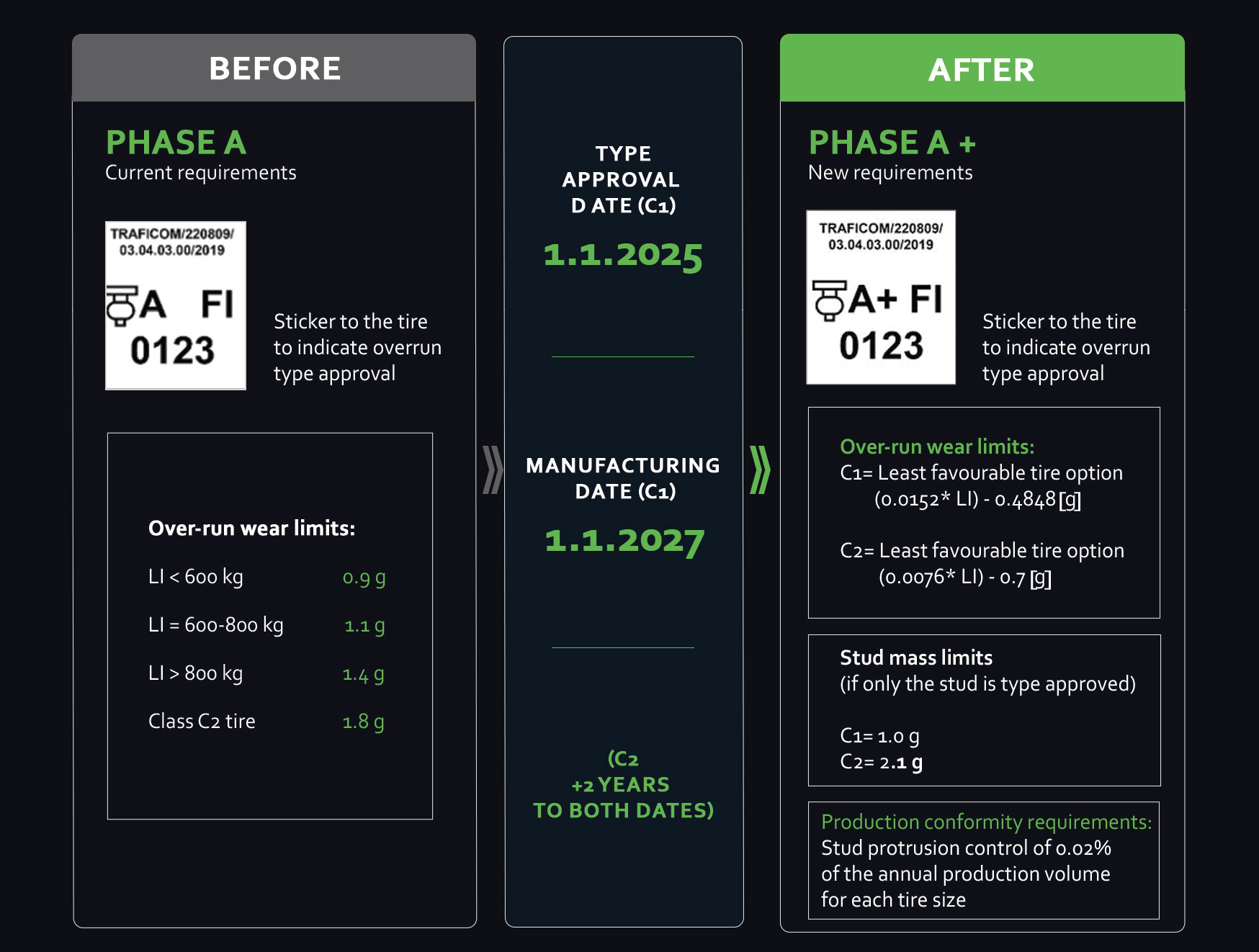
| 1 January 2025 | Phase A+ mandatory for all new Class C1 tire–stud type approvals |
| 1 January 2027 | Phase A+ mandatory for all newly manufactured Class C1 tires |
| 1 January 2029 | Phase A+ mandatory for Class C2 and C3 commercial vehicle tires |
New Road-Wear and Stud Mass Requirements
One of the most important technical changes is the tightening of allowable road-wear limits measured using standardized overrun testing in accordance with SFS 7503:2022. For passenger car tires, the regulation limits maximum road-wear values depending on tire load category.
For Class C2 commercial vehicle tires, the current Phase A limit is 1.8 g. Future Phase A+ requirements introduce stricter formula-based limits depending on tire load index.
If the tire is approved through over-run testing, there is no limit for stud mass. If fixed stud mass limits are followed, the number of studs per rolling circumference meter is limited to 50, and the stud itself must be type approved.
For Class C1 passenger car tires, the maximum stud mass decreases from 1.1 g in Phase A to 1.0 g in Phase A+.
For Class C2 commercial vehicle tires, the maximum stud mass decreases from 2.3 g to 2.1 g. The Class C3 stud mass limit remains unchanged at 5.0 g.
How EVs Are Increasing Winter Tire Development Complexity
Although electric vehicles are not specifically identified as a regulatory target, many of the new technical requirements align closely with EV-related development challenges. These include:
- Higher vehicle weight
- Increased torque
- Lower rolling resistance targets
- Lower noise requirements
- Greater focus on road wear and particle emissions
As a result, EV applications are creating additional challenges for winter tire development and industrialization
Production Conformity and Manufacturing Challenges
The regulation introduces significantly stricter conformity of production (CoP) requirements. Manufacturers must now demonstrate stable and repeatable production through:
- Stud protrusion measurements
- Annual production monitoring
- Reporting procedures
Corrective actions for non-compliance
The type-approval process itself is also becoming more demanding. The regulation introduces:
- Stricter testing procedures
- Controlled stud protrusion tolerances
- Standardized testing environments
- Mandatory testing of the least favorable tire–stud combinations
- More detailed reporting requirements
As a result, manufacturers increasingly need earlier validation, greater use of simulation, tighter prototype control, and stronger collaboration between development, manufacturing, testing, and quality teams.
What This Means for Tire Manufacturers
This regulation represents more than a technical update for Finland. It also increases pressure on manufacturers to improve environmental performance, traceability, and production consistency. The challenge is to ensure that tire systems meet environmental targets, pass increasingly strict approval procedures, and remain stable and repeatable in large-scale production. The regulation shifts focus from prototype-only approval to repeatable performance in industrial-scale manufacturing.
Manufacturers that integrate combine approval preparation, engineering, validation, and industrialization earlier in development will be better positioned for the next generation of Nordic winter tire regulations.
FAQ: Finnish & Nordic Studded Tire Regulations
Why are Finnish studded tire regulations important for global tire manufacturers?
Finland is considered one of the most demanding winter tire markets in the world due to its strict focus on winter safety, road wear reduction, environmental performance, and approval consistency. As a result, many tire manufacturers developing products for Nordic markets use Finnish requirements as an important benchmark during winter tire development.
Are Finnish studded tire regulations the same as EU regulations?
No. Finnish studded tire regulations are national regulations managed by Traficom and apply specifically to Finland. However, the regulations reflect broader Nordic and European trends related to sustainability, road wear reduction, traceability, and winter mobility performance.
Why is overrun testing becoming increasingly important?
Overrun testing measures the road wear caused by studded tires. As regulations become stricter, manufacturers increasingly need to balance ice grip, stud retention, noise, environmental targets, and approval readiness at the same time.
How are electric vehicles influencing winter tire development?
Electric vehicles introduce new challenges due to higher vehicle weight, instant torque, lower noise expectations, and rolling resistance targets. These factors are accelerating the development of lighter studs, optimized tire constructions, and improved production consistency.
Why is production conformity becoming more important?
The newer regulations focus not only on prototype performance but also on manufacturing repeatability and traceability. Manufacturers increasingly need stable industrial production processes that consistently meet approval requirements throughout the tire lifecycle.
Does Black Donuts support approval-oriented winter tire development?
Yes. Black Donuts supports tire manufacturers with winter tire engineering, simulation, studded tire development, testing coordination, approval preparation, manufacturing engineering, and production readiness support for Nordic and international markets.









Useful links: